How to Read a Sugar Reset Dropper Label
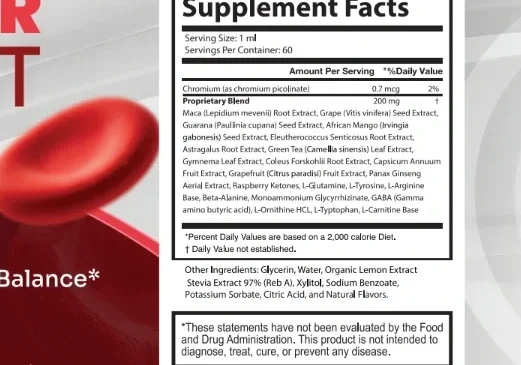
A liquid label counts servings in ml rather than capsules, and a bulb dropper fills by feel, not by a marked line. Sugar Reset's panel lists 60 servings of 1 ml, one printed chromium amount, and a 200 mg blend where the other 21 ingredients share one total with no individual amount published.
Why a dropper bottle reads differently to a capsule bottle
Say your last supplement came as capsules, and this one turned up as a small amber bottle with a dropper cap. The Supplement Facts panel looks familiar at first glance, then a few lines stop making sense. How much is "one dropper," really? Why does one line cover twenty-two ingredients at once?
This walkthrough takes those questions one at a time, using Sugar Reset's own panel as the working example. Nothing here is a judgement on whether the product works. It is a guide to reading what the bottle actually says, which is the part most people skip past.
Serving size: capsules count, drops do not
A capsule label counts in whole units: one capsule, two capsules, a scoop. A liquid label counts in volume, usually millilitres (ml), because a dropper cannot be counted the way a capsule can.
| Format | How a serving is written | How you'd measure it |
|---|---|---|
| Capsule bottle | 1 or 2 capsules | Tip the bottle, count them out |
| Sugar Reset (this product) | 1 ml, described as one dropper full | Shake, squeeze the bulb, fill the tube |
Sugar Reset's panel sets Serving Size at 1 ml, and the label's own directions say to take "1 or 2 droppers full daily." A capsule count is exact by definition; a dropper full is an estimate the bottle asks you to make yourself, every single day.
How accurate is a dropper, really?
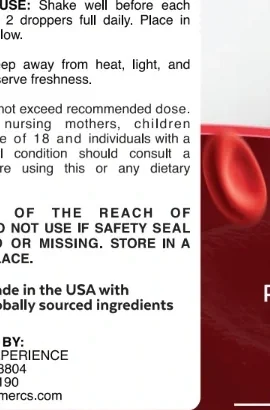
The directions crop above is where the range lives: "Shake well before each use. Take 1 or 2 droppers full daily. Place in mouth and swallow." Two different doses, both allowed, and the bottle leaves the choice to you every day you take it.
Worth saying plainly: this next point is general knowledge about how bulb droppers behave, not a finding from any study in our sources.
A bulb dropper without a printed graduation scale (no marked lines up the glass tube) fills by feel. How full it gets depends on how hard you squeeze, how quickly you release, the angle of the bottle, and how thin or thick the liquid is that day. A cold bottle pours differently to a warm one. None of that shows up on the label, and none of it is unusual for this kind of packaging.
The label's own instructions give you a range, "1 or 2 droppers," rather than a fixed amount. Stack an already-approximate fill against a two-times range, and the true dose you take on any given day could vary by a fair margin either way. For a product with no printed dose on most of its ingredients (more on that below), that variation is one more thing standing between the label and what actually reaches you.
A calibrated oral syringe, the kind a pharmacy hands out with children's medicine, solves this by marking exact ml lines on the barrel. A plain bulb dropper does not offer that precision, and this bottle ships with the bulb kind.
Servings per container, and how long a bottle actually lasts
Servings Per Container tells you how many doses are packed into the bottle: 60 on this label, inside a 2 fl oz (60 ml) bottle. That number only turns into "days of use" once you know your own daily rate, and the label allows two different rates.
| If you take | Doses used per day | How long one bottle lasts |
|---|---|---|
| 1 dropper (1 ml) | 1 | 60 days |
| 2 droppers (2 ml) | 2 | 30 days |
That gap matters for budgeting a kit. Multi-bottle deals are often built around the higher rate, so worth checking your own plan against it before assuming a kit covers as many weeks as its name implies. Full breakdown on how to use Sugar Reset.
One blend total, instead of one line per ingredient
- Maca Root Extractnot published
- Grape Seed Extractnot published
- Guarana Seed Extractnot published
- African Mango Seed Extractnot published
- Eleuthero Root Extractnot published
- Astragalus Root Extractnot published
- Green Tea Leaf Extractnot published
- Gymnema Leaf Extractnot published
- Coleus Forskohlii Root Extractnot published
- Capsicum Annuum Fruit Extractnot published
- Grapefruit Fruit Extractnot published
- Panax Ginseng Aerial Extractnot published
- Raspberry Ketonesnot published
- L-Glutaminenot published
- L-Tyrosinenot published
- L-Arginine Basenot published
- Beta-Alaninenot published
- Monoammonium Glycyrrhizinatenot published
- GABA (gamma-aminobutyric acid)not published
- L-Ornithine HCLnot published
- L-Tryptophannot published
- L-Carnitine Basenot published
The equal bars are a stand-in, not a measurement. Twenty-two names sit inside a single 200 mg figure on the label. An even split would give roughly 9 mg apiece, yet the maker never says how the 200 mg is shared.
A capsule label built from single ingredients usually gives each one its own line and its own milligram figure. This panel does something different: 22 plant extracts and amino acids sit under one heading, "Proprietary Blend," with a single combined weight of 200 mg.
US labelling rules allow this. A maker can print the total weight of a blend without breaking out each ingredient's share, as long as every ingredient in it is listed by name, in descending order by weight. That second part is the one clue you get: whatever is listed first weighs the most, and whatever is listed last weighs the least.
What "not published" means in practice
"Not published" sounds like a technicality. In practice it closes off three things you might want to know before you take a dropper full of anything.
- You cannot compare any single ingredient's amount to a research dose, because the label does not give you one
- You cannot work out how much caffeine, if any, a dropper delivers when the caffeine sources sit inside an undisclosed blend
- You cannot tell whether the smallest-listed ingredients are present in a meaningful amount or in a trace so small it barely counts
None of that means the blend is fake. It means the panel, read on its own terms, cannot answer those three questions, and no amount of careful reading changes that. Our ingredient breakdown lays out what research exists for each named plant despite the missing amounts.
Walking this product's own panel, line by line
Put all of that together and here is Sugar Reset's own Supplement Facts panel, read straight through.
| Line on the panel | What it says | What it means for you |
|---|---|---|
| Serving Size | 1 ml | One full dropper is treated as one dose |
| Servings Per Container | 60 | 60 days at one dropper, 30 at two |
| Chromium (as chromium picolinate) | 0.7 mcg, 2% DV | The one ingredient with its own printed number, and a tiny one |
| Proprietary Blend | 200 mg † | The combined weight of the 21 remaining ingredients below it |
| Individual blend amounts | Not published | Guarana, green tea, gymnema, grapefruit extract and the rest share the total above, unlabelled |
Chromium (as chromium picolinate) is worth a second look because it is the only figure on the page you can actually check against anything: 0.7 mcg, listed at 2% of the Daily Value. NIH's Office of Dietary Supplements sets an everyday Adequate Intake for adults of 25 to 35 mcg a day, so this one printed figure already sits well under the ordinary daily target, before any research dose enters the discussion (National Institutes of Health, 2024).
Everything below the blend heading, from maca root down to L-carnitine, is real and named. What is missing is how much of each. That distinction, named but not measured, is the one to carry into every other page on this product. Full panel image and context: the Supplement Facts page.
A short checklist for reading any liquid supplement label
Find the serving size and the unit
Capsules, ml, drops or scoops. A liquid measured in ml needs a steadier hand than a capsule count does.
Check servings per container against your own rate
Divide it by how many servings you actually plan to take a day, not the rate a kit's name assumes.
Look for a blend heading
A single combined weight covering several ingredients means no individual amount is coming, no matter how far down the label you read.
Note anything printed as "not established" or left off entirely
That is your cue to treat any comparison to a research dose as impossible, not just difficult.
Read the directions as a range, not a fixed rule
"1 or 2 droppers" is two different doses. Pick one and stay consistent so at least your own use is steady.
Reading the panel carefully is not the same as treating Sugar Reset as a diabetes treatment. Whatever the label says or leaves unsaid, keep taking any prescribed medicine and keep testing on your usual schedule unless a clinician tells you otherwise.
For the caffeine and grapefruit questions this panel raises specifically, see our piece on what hides inside a metabolic blend. For the habits that do the most work day to day, regardless of what a dropper contains, see habits that steady blood sugar.
Questions readers ask
Is a dropper full the same as 1 ml every time?
Not exactly. The label states Serving Size as 1 ml, but a bulb dropper without a marked scale fills by feel, so the true amount can vary a little from one squeeze to the next.
Why do capsule labels list separate amounts but this one doesn't?
This product groups 21 ingredients under one blend heading with a combined weight, which US rules allow as long as every ingredient is named in descending order by weight. A capsule label with single ingredients usually has no reason to do that.
What does "Daily Value not established" mean?
It means no federal reference amount exists for that ingredient or blend, so the panel cannot show a percentage the way it does for chromium.
How long does one Sugar Reset bottle last?
60 days at one dropper a day, or half that, 30 days, at two droppers a day, since the label allows either rate.
Can I work out how much caffeine is in a dropper?
No. Guarana and green tea sit inside the undisclosed blend total, so no caffeine figure can be calculated from what the label prints.
Is it legal for a supplement to hide individual ingredient amounts like this?
Yes. A combined blend weight with ingredients listed by descending weight order is allowed under US labelling rules, though it leaves each individual amount unknown to the reader.
Does maca being listed first mean it's the main ingredient by amount?
By weight, yes, since US rules require blend ingredients to be listed in descending order. It does not tell you the actual milligram figure, only that it outweighs everything listed after it.
Where can I see Sugar Reset's full label?
Keep reading
Caffeine and grapefruit in supplements
Why guarana and green tea add unlisted caffeine to metabolic blends, why grapefruit extract concerns pharmacists, and ho...
Read →Habits that steady blood sugar
Meal composition and order, walking after eating, sleep, alcohol, stress and weight, plus a fair way to judge whether a ...
Read →How much does Sugar Reset cost?
Kit sizes, how long each lasts and which one suits a first order.
Read →Start the Sugar Reset routine from the authorized outlet
Sixty 1 ml doses fill every bottle, and the kits work out at $79, $69 or $49 a bottle with sixty days to ask for a refund. Not sure which kit fits your routine? The kit comparison sets them side by side.